Current Research

Didymo on rock

Extreme case of Didymo bloom in Nashua River, New Hampshire. Photo credit: Amy Smagula.

Didymosphenia geminata, “rock snot”- Within the last several years, Didymo has invaded a number of locations in the Northeast United States. My collaborators and I are interested in determining where Didymo exists and understanding if there are biogeochemical explanations or the recent invasion. We would like to quantify the extent of the blooms (biomass accrual) and to understand the impact of the blooms on the physical template of the streams (seston quality and transport), the biogeochemical implications of the blooms (nutrient cycling) and the effects on the higher trophic communities of macroinvertebrates and fish.

Visit our facebook page for updates on our didymo research.


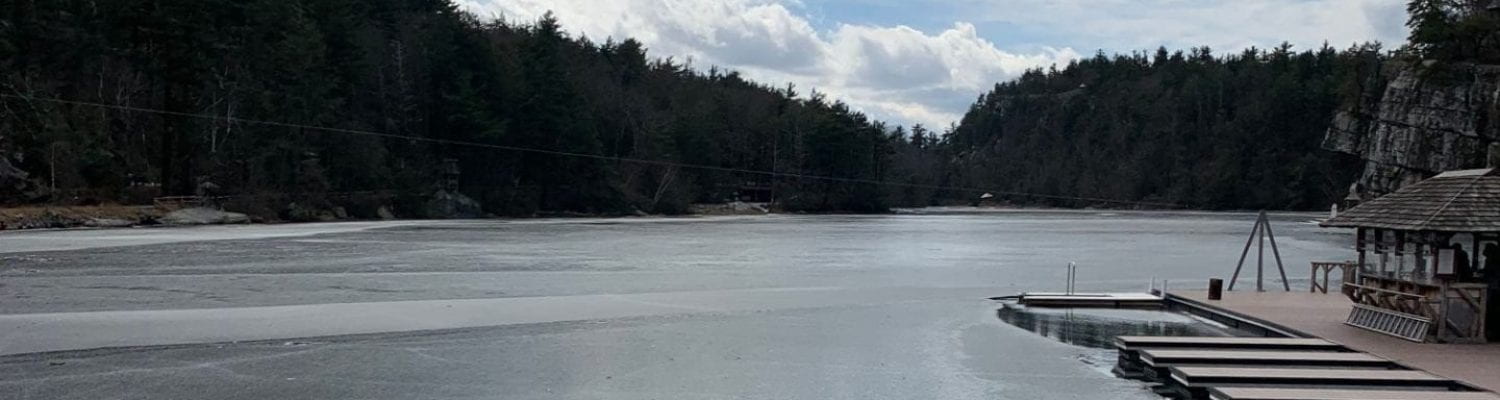
Lake Minnewaska with student kayakers.

Lake Minnewaska and other sky lakes- Lake Minnewaska is one of five sky lakes that run along the Shawangunk Ridge in Ulster County, New York. A fishless ecosystem for nearly a century, Lake Minnewaska had developed a unique ecology due to its outstanding clarity.  For example, Lake Minnewaska is home to a water moss observed deep in the lake and constitutes the majority of the vegetative carpets on the lake bottoms.  Also, the fishless, acidic Lake Minnewaska is a suitable environment in which Two-Lined salamanders (Eurycea bislineata) could breed without fear of predation and the salamander have been observed for over 20+ years. In late 2008, early 2009, small bait fish (Golden Shiner minnow or Notemigonus crysoleucas) between 2 and 10 cm have been frequently observed near the shore of Lake Minnewaska since their introduction via recreational users. In this historically clear water (oligotrophic) lake, several broad scale changes have occurred since the minnow’s introduction. Water clarity has decreased and more algal blooms have turned the lake green.  We are trying to understand the changes to the lake and evaluate the potential for minnow removal.


Lake Metabolism – Ecologist use different measurements to describe the dynamics of ecosystems.  We use structural measurements like temperature, chlorophyll a concentration, or dissolved oxygen.  These represent snapshots of the ecosystem at a time. On the other hand, functional measurements such as respiration, photosynthesis, and other metrics of ecosystem metabolism represent active processes and can be sensitive to environmental change.  I am working with several collaborators on projects looking at functional metrics in aquatic ecosystems (e.g. streams, rivers, lakes, estuaries) around the world using automated sensors and mathematical modeling. 


Orconectes limosus from White Clay Creek, PA.

Bioturbation and particle export – In a previous study in White Clay Creek (WCC), a 3rd-order southeastern Pennsylvania stream, suspended particle concentrations exhibited a strong diel pattern; nighttime concentrations exceeded daytime concentrations by 80% (Richardson et al. 2009). The day/night pattern was thought to have been caused by the activity of the nocturnal stream community, including crayfish, amphibians, eels, and macroinvertebrates. I am interested in determining if bioturbation (stirring up of stream sediments) by crayfish and salamanders is a mechanism for nighttime increases in seston transport. Crayfish and salamander density, size, and nocturnal activity make them ideal candidates to modify ecosystem level processes such as the downstream transport of seston and particulate organic carbon.


Lake Sunapee Buoy

Lake Sunapee Protective Association water quality monitoring buoy, Sunapee, NH. Photo credit: Midge Eliassen.

Cyberinfrastructure (CI) and aquatic ecology – A community group (Lake Sunapee Protective Association: LSPA) has a buoy installed on Lake Sunapee to monitoring real-time air and water environmental parameters. Part of the challenge is to get citizen scientists (including undergraduates) interested and involved in real-time lake data collection and interpretation from monitoring buoys. Our research group presently helping the LSPA and their citizen scientists (members, home-owners, educators, undergraduate students) co-design cyberinfrastructure (web interfaces) that will allow them to access and understand the high frequency data.


Lake Sunapee

Lake Sunapee looking north from Mount Sunapee. Photo credit: Midge Eliassen.

Non-point source pollution to Lake Sunapee - Lake Sunapee, the sixth largest lake in New Hampshire, is located in a rapidly developing watershed, and the lake and its watershed are the primary focus of an active non-profit education and outreach organization, the 100 year-old Lake Sunapee Protective Association (LSPA). In partnership with the LSPA, several collaborators and I are using field sampling to quantify how watershed characteristics interact with precipitation to determine the type, rate, and magnitude of sediment and phosphorus (P) inputs to Lake Sunapee. We are working to determine where and when best management practices need to be applied to minimize P loading to Lake Sunapee.


Wallkill River

Rte 299 (Main Street) bridge over the Wallkill River in New Paltz.

Wallkill River and tributary research - The Wallkill River flows from its source, Lake Mohawk in Sparta, New Jersey, 94 miles north, through two states and three counties, to Ulster County, NY where it enters the Hudson River. At the source, Lake Mohawk is a man-made lake surrounding by a golf course and urban development. As the river flows north, there are several closed mines which are potential sources of arsenic to the surface waters, a wildlife refuge that covers nine river miles, several dams, agriculture, and several small towns. These features of the watershed may contribute pollutants to the Wallkill, such as nutrients, heavy metals, pesticides, or pharmaceutical by-products. We seek to quantify how watershed land use and land cover over the length of the Wallkill River affect the temporal and spatial variability of sediment and nutrient fluxes within the Wallkill River.

Comments are closed.